Showing posts with label instrument stage 2. Show all posts

Monday, July 1, 2019

Ground Lesson 21 (9): Departure charts and procedures

Departure charts

  • Obtaining charts
  • Departure standards
    • Climb at least 200 feet/NM until minimum IFR altitude 
    • Cross departure end of runway at least 35 feet AGL
    • Climb to 400 feet AGL above departure end of runway before turning 
    • Assessment area extends 25NM from airport in non-mountainous and 46NM in mountainous terrain
      • Beyond this distance it is the pilot's responsibility for obstacle clearance

    • Must make sure your aircraft is able to perform the climb necessary

  • Instrument Departure Procedures (DPs)
    • Purpose 
      • Provides transition between departure airport and enroute segment 
      • Simplifies clearance delivery 
      • Reduces radio congestion 
      • Ensures obstacle clearance 
      • Makes departure more predictable 
        • Controls the flow of traffic

    • Diverse departure assessment area 
      • If an aircraft may turn in any direction from a runway within the limits of the assessment area and remain clear of obstacles that runway passes what is called a diverse departure assessment
        • No ODP is published.

  • Obstacle Departure Procedures (ODPs)
    • Do not need ATC clearance 
    • Developed only for obstacle clearance
    • Usually textual but can be graphical if it is complex ( tabled “obstacle”)
    • As a general rule, ATC will only assign an ODP from a non-towered airport when necessary for traffic separation
    • Intended to be used only in the absence of radar vectors or SID
  • Standard Instrument Departures (SIDs)
    • To reduce congestion and pilot/controller workload
    • Always depicted graphically, usually accompanied by explanatory text 
    • Developed by ATC based on
      • Most frequent transition 
      • Noise abatement
      • Obstacle clearance

    • RNAV SID’s can only be flown with IFR approved RNAV equipment 
    • ATC clearance for a specific SID must be given prior to flying a SID

  • Diverse Vector Area
    •  This DVA may be established below the MVA or Minimum IFR Altitude (MIA) in a radar environment at the request of Air Traffic

  • Vector DPs
    • ATC provides vectors that start after takeoff
    • Continue until you reach filed assigned route or one of the fixes on the chart 
    • Does not show departure routes or transitions 
    • Usually contains an initial heading and altitude to climb

  • Chart format and symbology
Departure procedures
  • Takeoff minimums 
    • FAR 91.175 (f)
    • Use minimums from commercial operators
    • For aircrafts with 2 engines or less,Visibility 1 SM
    • For aircrafts with more than 2 engines, visibility ½ 
    • Do not depart if weather is so bad that you cannot return to the airport in case of emergency 
    • Note the minimum safe altitude 
    • Non-standard takeoff minimums 
      • This means the minimums are higher than standard
      • Indicated by a triangle - T 
      • Published in the front of the terminal publications

  • Departure chart
    • Obstacle notes
      • These are low obstacles within 1 NM of departure runway that penetrate the standard design criteria 
      • They would require a higher climb rate than 200 feet/NM
      • Instead notes are published so pilots can avoid them

  • Graphic departure procedures
  • Textual departure procedures
  • Radar departures
    • The tower will advise you of a heading to fly
    • Might be issued in IFR clearance or just before takeoff
    • Coordination of your flight is now responsibility of the controller

  • VFR departures
    • Could be an alternate to a departure procedure if conditions permit 
    • You are responsible for obstacle clearance and traffic separation 
    • Must obtain clearance before entering IMC 
    • You can also request “climb in VFR”

  • Selecting a departure method
    • Choose departure that will give smoothest transition 
    • Make sure your aircraft can handle the required minimums 
    • Must be in possession of at least a textual version of the departure


      .

Ground Lesson 22 (10): Enroute charts and procedures

Enroute and area chart
  • Enroute charts
    • Navaids 
      • Localizer is only shown when it can be used to ID a fix

    • Victor airways 
      • Even numbers for east/west - odd numbers for north/south
      • Some victor airways can share one or more segments

    • MTA/MCA → minimum turning/crossing altitude
      • Usually only applies above 10000 feet MSL
      • Will be charted by (X) - flag accompanied by a note

    • MEA → minimum enroute altitude 
      • when you file a flightplan, you should fly at least this altitude

    • MOCA → minimum obstacle clearance altitude
      • Obstacle clearance
      • Navigational signal assured within 22nm of VOR

    • OROCA
      • Obstacle clearance (1000/2000)

    • Single direction route are indicated by an arrow on the black box with the victor airway number 
    • Change over points 
      • Given when you should switch to the next VOR at another point than halfway
      • They will indicate the distance on both VOR’s

  • Front panel
  • Communication
    • Radio technique 
      • Proper communication is critical in IFR flight
      • Work on effective listening 
      • Watch out for similar call signs
      • Question anything you find confusing or unclear
      • Listen before you transmit to not step over other people 
      • Think before you transmit 
      • read back frequency change 
      • State altitude on initial contact 
        • ATC can compare reported altitude with transponder

  • Airports
    • Civil airports 
      • Green symbol → available IAP
      • Blue symbol → civil and military approach procedure 
      • Brown → no instrument approach

  • Airspace
    • Indicated by a box under the airport name 
    • Lateral dimensions are only given to class B and C

  • Area charts
Enroute procedures
  • Enroute radar procedures
    • You will be handed off from “departure” to ARTCC
    • Radio communication will be 
      • “Aircraft 123, Portland departure, contact Seattle center on 124.2”
      • Answer:  Seattle center 124.2, Aircraft 123

    • From there you get handed off between ARTCC controllers 
    • Read back frequency change so the controller doesn't worry about lost com.
    • Initial contact to Seattle center
      • Seattle center, Aircraft 123 level/climbing/descending  1400 for 2300
        • This is to verify mode C altitude

  • Reporting procedures
    • Reporting procedure at all time 
      •  Marvelous VFR 5 - C

M
Missed approach 
A
Airspeed change +/- 10kts or 5% of filed airspeed whichever is greater
R
Reaching a holding point/fix. Report time and altitude
V
VFR on top 
E
ETA change =/- 3 mins ***
L
Leaving a holding fix/point
O
Outer marker ***
U
Unforecasted Weather
S
Safety of flight
V
Vacating an altitude
F
Final approach fix ***
R
Radio/nav failure
5
unable to maintain a 500 fpm climb
C
Compulsory reporting fix 


    • Reporting in non radar coverage 
      • Over compulsory reporting point if you don't have radar coverage 
        • Outside radar coverage is very rare ( normally radar failure)

  • Enroute navigation using GPS
    • Load way-points

  • Air traffic service routes
    • Designed for channeling the flow of traffic as necessary for the provision of air traffic services

  • Enroute RNP
    • Ground Lesson 16

  • Special use airspace
    • Ground Lesson 6

  • Temporary flight restrictions
    • Ground Lesson 6

  • IFR cruising and minimum altitudes
    • Ground Lesson 6  / chart

  • Descending from the enroute segment
    • ATC will give you a descent clearance so you arrive in the approach control airspace 
    • AIM 5 - 3 → enroute procedure

  • Reduced Vertical Separation Minimums (RVSM)
    • Reduction of vertical space between aircraft from 2,000 to 1,000 feet at flight levels from 29,000 feet up to 41,000 feet
    • Implemented as a means to increase airspace capacity and access to more fuel-efficient flight levels


      .

Ground lesson 23 (11) - Holding procedure

Holding procedures


  • Reasons for a hold
    • Spacing
    • Bad weather
    • Missed approach procedure 
      • Leads you to the fix where you hold until further instructions 
      • If you can't land for some reason
        • Losing glideslope or localizer (full deflection)
        • Can't see airport at minimums

  • Points of a hold

    • The fix
      • NBD, VOR, etc
      • Hold always begins at the fix

    • Inbound radial
      • The leg is always flown towards the fix

    • Fix end
      • The turn from fix to outbound leg

    • Outbound leg
      • Starts abeam the fix
      • The turn from outbound leg to inbound leg is called outbound end
  •  Holding procedure 
    • Standard patterns → right turns 
    • Draw a line 70º into the hold
    • 3 different suggested entries 
      • Direct entry
      • Teardrop entry  → turn 30º into the hold
      • Parallel entry → fly outbound for 1 min then turn into the hold and re-intercept

    • Fly each leg for 1 minute 
      • Adjust outbound leg so that inbound leg is 1 minute


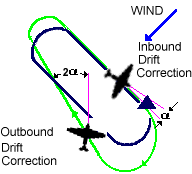
  • Cross wind correction 

    • Use 3x the inbound correction on the outbound


  • Max holding speeds
    • 200 IAS at 6000 MSL and below
    • 230 IAS at 6001 MSL to 14000 MSL
    • 265 IAS above 14000 MSL

  • ATC holding instructions
    • Usually be issued 5 min before the hold
    • If there is a chartered hold ATC might say “hold as published” otherwise
      • Direction from the fix
      • Name of the fix
      • Course (from radial)
      • Leg length
      • Direction of turn
      • EFC time

    • Maintain altitude unless instructed otherwise 
    • Fly right turns unless left turns are assigned 
    • Always report time and altitude when reading holding fix
      • “Pdx approach, 4097L, Newberg VOR at 5000, 2300 holding south”

  • EFC time- expect further clearance 
    • Don't accept a hold without an EFC time 
    • Efc time allows you to leave the holding fix at a specific time if you lose communication


      .

Ground Lesson 24 (12): Arrival charts and procedures

Arrival charts

  • Standard Terminal Arrival Routes (STARs)
    • Developed as link between enroute structure and approach procedure 
    • Works the same as a departure procedure to reduce workload
    • You have to have the arrival chart in your possession to fly it 
    • Usually serves more than one airport

  • Interpreting the STAR
    • Looks like a departure procedure , but reversed 
    • Officially begins at the BOLD segment where all the transitions for the arrival come together 
    • All altitudes are in MSL and distances are in NM
    • AIM - 5-4-1 STARS

  • Vertical navigation planning

Arrival procedures


  • Preparing for arrival 
    • Highest workload
    • IMARTHA - reviews the approach
    • Listen to the ATIS as soon as possible 
    • Set frequencies

  • Altitude 
    • ATC will clear you for a specific altitude until established on a published segment of the approach
    • Feeder routes are part of the approach when cleared for the approach


      .

Ground Lesson 25(13): Approach charts

Approach segments

  • Feeder routes
    • en route structure to the initial approach fix
  • Initial approach segment
    • This segment starts at the IAF - initial approach fix 
    • The purpose is to align your aircraft with the approach course 
    • Can be DME arc, procedure turn, or holding pattern

  • Intermediate approach segment
    • Starts at the IF - intermediate fix 
    • Designed to position your aircraft for the final descent to the airport 
    • Reduce your airspeed to the approach speed and complete FAF briefing (TAMALL)
    • Some charts don't show IF
      • Starts when you intercept the inbound course after completing the procedure turn

  • Final approach segment
    • Starts at the FAF - final approach fix
    • Allows you to navigate safely to the airport 
    • Can't see the airport environment at the MAP you must execute a missed approach
    • If the approach does not have a FAF, it starts when you are established inbound after completing the PT

  • Missed approach segment
    • Starts at the MAP
    • Allows you to navigate to a point where you can try again or continue to another airport

Approach chart layout
  • Approach name conventions
    • HIO VOR/DME C
      • “C” stands for the third circling only approach to that airport 
      • VOR/DME means you must have both VOR/DME equipment
    • BFI RNAV(GPS) Y Runway 13R
      • “Y” stands for the second approach of the same type to the same runway
      • Starts at “Z” and goes backwards
      • BFI also has RNAV(GPS) Z runway 13R
  • Heading section
    • The “header” of the approach plate 
    • Gives the name of the approach, airport name, city, and state
    • This title is used by ATC when they clear you for the approach

  • Briefing information
    • What you should brief before starting the approach 
    • Contains approach course, frequencies, and elevation

  • Minimum safe altitude
    • Provides 1000 feet obstacle clearance within 25 NM of the indicated facilities
      • (same for mountainous and non mountainous )

    • Divided into sectors
    • Does not guarantee NAV or, COMM coverage
    • Designed only for use of an emergency

  • Plan view
    • Middle section where you see the approach from above 
    • Missed approach segment shown with dotted line

  • Profile view
    • Bottom section where you see the approach from the side

  • Step-down fix and Visual Descent Points (VDP)
    • As you pass certain points you may descend down to a new altitude
    • VDP = visual descent point 
      • A point from which you can make a normal descent to a landing from the MDA

  • Missed approach icons
  • Conversion table
    • Rule of thumb → groundspeed/2 * 10 feet/minute

  • Landing minimums
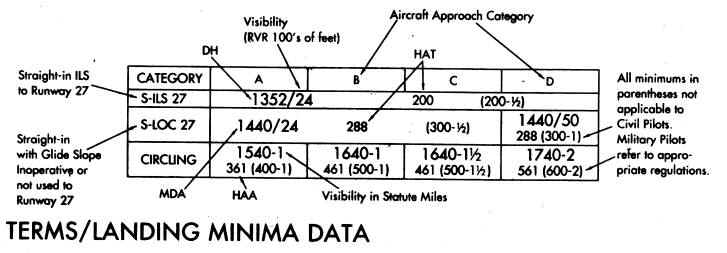
    • MDA → minimum descent altitude for non precision approaches
    • DA → decision altitude for precision approaches 
    • Provides altitude and visibility requirements 
    • Circling minimums → you proceed to the runway but circle to land
    • On a non-precision approach, you CAN NOT descend below the MDA 
      • Based on speed
  • Aircraft approach categories
    • Based on speed


  • Minimum descent requirements
  • Visibility requirements
    • Operation below DA/DH or MDA
      • Flight visibility is not less than the visibility prescribed in the standard instrument approach
      • Except for a Category II or Category III approach at least one of the following visual references for the intended runway is distinctly visible and identifiable to the pilot
        • The approach light system, except that the pilot may not descend below 100 feet above the touchdown zone elevation using the approach lights as a reference unless the red terminating bars or the red side row bars are also distinctly visible and identifiable.
        • The threshold.
        • The threshold markings.
        • The threshold lights.
        • The runway end identifier lights.
        • The visual glideslope indicator.
        • The touchdown zone or touchdown zone markings.
        • The touchdown zone lights.
        • The runway or runway markings.
        • The runway lights.

  • Inoperative components
    • The lowest landing minimums are authorized only when all components are operational
    • When on component is inop. You must increase altitude and/or visibility 
    • More than one component is inop. Apply the greatest increase required by any single inop component
    • When glide slope becomes inop. Use LOC minimums 
    • Inop. component table in TPP’s

Approach chart layout – airport chart
  • Heading and communications sections
  • Plan view and additional runway information
  • Takeoff and alternative minimums .

Ground Lesson 26 (14): Approach procedures

Approach procedures

  • Preparing for the approach
    • Preflight
    • IMARTHA
    • 6T’s - each fix

  • Approach chart review
    • IMARTHA

  • Approach clearance
    • You must be cleared for the approach before executing

  • Executing the approach
    • You must have at least a textual approach plate with you to execute the approach

  • Straight-in approach
  • Use of ATC radar for approaches
  • Approaches which require a course reversal
    • Used when necessary to reverse your direction to align aircraft with the final approach course 
    • If a procedure turn is charted, you must fly the procedure turn
    • Exceptions 
      • Controller clears you for a straight in
      • “No PT”
      • Vectors to final
      • Timed approach from a holding fix
      • Hold in lieu

  • Timed approaches from a holding fix
    • You are given a time  to depart the holding fix inbound
    • Adjust your holding pattern to leave the fix at the given time

  • Final approach
    • Tamall
    • Start looking for the runway

  • Circling approaches
    • Circling from the final approach course to reach your desired runway
    • Must remain at or above circling MDA until you can make a normal descent for landing
    • Must remain 1.3 NM radius from the end of all runways in “category A”

  • Sidestep maneuver
    • May be necessary where there  are two parallel runways
    • Follow approach course to one runway then sidestep to the other as soon as possible when in sight

  • Missed approach procedures
    • Execute when over the missed approach point and runway not in sight → Fly to the hold

  • Contact approach (AIM 5 - 4 - 25)
    • Something you can request if you are clear of clouds and 1 SM visibility 
    • ATC can't initiate it, you must request it 
    • Used in lieu with an IAP, you can proceed to land in visual conditions
    • You are responsible for obstacle clearance 
    • ATC provides separation from IFR and SVFR traffic, not VFR

  • Visual approach (AIM 5 - 4 -23)
    • IFR procedure that authorizes a pilot to proceed visually and clear of clouds 
    • ATC can assign it or you can request it 
    • You must have airport or proceeding identified aircraft in sight 
    • Weather must be at least 1000 foot ceilings and 3 SM visibility 
    • VFR cloud clearance not applicable 
    • No missed approach, only go around
    • If you report proceeding aircraft in sight, you are responsible for traffic separation

  • Approach types 
    • Precision approach
      • ILS: instrument landing system
      • PAR: precision approach radar 
      • MLS: microwave landing system (none in USA since 2008)

    • Non-precision approach
      • LOC → localizer
      • VOR → vhf omnidirectional range 
      • NBD → non directional radio beacon 
      • ASR → airport surveillance radar 
      • LDA → localizer type directional AID
      • SDF → simplified directional facility 
      • RNAV → area navigation

  • APV - approach with vertical guidance
    • Does not meet precision approach standards 
    • RNAV
      • LPV → localizer performance with vertical guidance 
      • Lnav/Vnav → lateral/vertical navigation 
      • baro-Vnav → uses aircraft's altimeter to compute and present a glide path to the pilot


        .

Ground Lesson 27 (15): VOR and NDB approaches

VOR and NDB approaches

  • VOR approach procedures
    • Usually easier to fly, but less precise
    • MDA’s range from 500 feet - 1000 feet above TDZ(touchdown zone)
    • Two types
      • Off airport facility 
      • The VOR is not placed at the airport
      • On airport facility
        • The VOR is placed at the airport

  • VOR/DME approach
    • Do you need DME equipment if the approach titles VOR/DME
      • Yes, otherwise it would say “OR”

    • Can you use GPS for DME
      • Yes, AIM 1-2-3 allows this

    • Some VOR approaches still provide DME information, but DME is not required (VOR)

  • NDB approach procedures
    • Similar to a VOR approach 
    • Accuracy depends on your skill using ADF navigation

  • Radar vectors to the approach
    • It is pretty common to get vectors to final 
    • Better for both you and the controller 
    • Twist OBS to final approach course 
    • Only do a procedure turn if ATC clears you to do it

  • VDP - visual descent point 
    • A point where you can begin a normal descent from the MDA to the runway, if you have visual req.


      .

Ground Lesson 28 (16): ILS approaches

ILS approaches


  • ILS categories and minimums
    • Category 1
      • Basic ILS approach
      • Requires only that you are instrument rated and current

    • Category 2/ category 3
      • Typically provides lower minimums
      • Requires special certification for pilots, aircraft and air/ground equipment

  • ILS components
    • Localizer 
    • Glideslope
    • Approach lights 
    • Marker beacon

  • Localizer 
    • Provides lateral guidance
    • Placed on the departure end of the runway
      • More sensitive on the back course

    • The signal represents only one magnetic course to the runway
    • Regardless of what course you select, the CDI will indicate the same off course
      • This can be compared to GPS navigation and cid indication
      • Always set to the approach course for easier guidance

    • You will get reverse sensing if you set and HSI/VOR to the inbound localizer back course
      • Always set to the inbound front course

    • Full deflection is 2.5º
      • 4x more accurate than a VOR(10º full deflection)
      • Also more sensitive CDI

    • Signal is provided up to 4500 feet


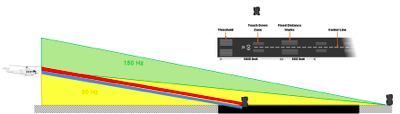
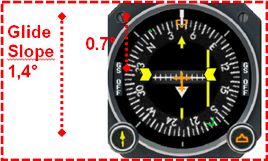
  • Glide slope 
    • When you set the LOC frequency you automatically get the glide slope 
    • 0.7º full deflection 
    • Usually works up to 10 NM and usually a 3º glide slope, but can be different, depends on terrain


  • Marker beacons
    • Used to help you ID a position on the approach 
    • Usually only two marker beacon associated with a normal ILS.
      • Outer marker (FAF)
      • Middle marker - DA
      • Inner marker
      • Back course marker

    • When you fly over a marker, you will receive a light and sound


  • Compass locator 
    • low power NBD transmitter installed together with the OM and MM on some ILS approaches
  • Inoperative components
    • The lowest landing minimums are authorized only when all components are operational
    • When on component is inop. You must increase altitude and/or visibility 
    • More than one component is inop. Apply the greatest increase required by any single inop component
    • When glide slope becomes inop. Use LOC minimums 
    • Inop. component table in TPP’s
  • Flying the ILS
    • ID the ILS/LOC frequency
    • Intercept the localizer 
    • Maintain localizer and glideslope centered
  • Straight-in (NoPT) ILS approach
  • ILS approach with course reversal
    • Fly procedure turn/hold, then intercept the LOC
  • ILS/DME approach
  • Radar vectors to ILS final approach course
    • ATC will vector you to the FAF
  • ILS approaches to parallel runways
  • Simultaneous converging instrument approach
  • Localizer approach
    • LDA - localizer type directional AID
      • More precise than SDF
      • If not aligned with the runway, may still provide straight in if less than 30º off
      • Limited approaches have glide slope
    • SDF - simplified directional facility 
      • Localizer type, may be wider(16 or 12 degrees) - less precise 
      • May or may not be aligned with runway 
      • No glide slope
  • Localizer back course approach .

      Ground Lesson 29 (17): RNAV approaches

      RNAV approaches


      • Approach design
        • Basic T design
        • Could be other designs based on terrain
        • FAF is usually 5 NM from threshold 
        • MAP usually at the threshold, and fly over point 
          • Common fail during stage checks and check rides 
          • You have to fly over that point before starting a turn
          • You can start climbing before

      • Terminal Arrival Area (TAA)
        • Provides transition from the en route structure to the terminal environment for arriving aircraft equipped with Flight Management System (FMS) and/or Global Positioning System (GPS)

      • Waypoints
        • Fly over and fly by

      • Required navigation performance (RNP)
        • Ground Lesson : Radio navigation

      • GPS approaches
        • Two major category 
          • Overlay
            • Based on a ground based NAVAID like a VOR
            • This is when the title says “VOR or GPS”

          • Stand alone 
            • Designed only for GPS
            • Usually offers more effective routing
            • Use the basic T structure when possible

      • Lateral Navigation/Vertical Navigation (LNAV/VNAV)
        • Ground Lesson: Approach procedures

      • VNAV descent profile Approach with Vertical Guidance (APV)
        • Ground Lesson: Approach procedures

      • Precision approaches
        • Ground Lesson: Approach procedures

      • GPS equipment requirements
        • Ground Lesson : Radio navigation
        • GPS must be IFR approved 
          • That info can be found in the manual

        • Aircraft's must be equipped with an approved and alternate means of navigation

      • Receiver Autonomous Integrity Monitoring (RAIM)
        • Ground Lesson : Radio navigation

      • Navigation database
        • Ground Lesson : Radio navigation

      • GPS navigation considerations
        • Alternate airport must have other than GPS approach
        • The approach must say GPS to be able to use your GPS for the approach
        • Radar vectors to a GPS approach
          • Go to GPS procedure page and activate vectors to final

      • Radar vectors to a GPS approach

      .